Fat Politics and Health at Every Size

Given the general antipathy toward fatness and fat people in our society, we take a minority position. We hold to the intersectional feminist view that bodies of all shapes and sizes are valid and have beauty.
We know we cannot discern anything about a person’s habits or character by the shape or size of their body; bodies of all shapes and sizes may be healthy or unhealthy. For this reason, Our Bodies Ourselves does not include resources that endorse weight loss in any way, use weight as a metric for health, or negatively frame larger-bodied people (e.g., “the obesity epidemic.”)
It may be the case that each of us has an ideal physical condition, which we should be free to pursue to whatever extent we choose. But widespread discrimination against large-bodied people, especially large-bodied women is a form of oppression that needs to stop. We oppose the (extremely profitable) hamster wheel of weight loss diets, drugs, “wellness,” and exercise regimens, which siphon off so much of our time, money, as well as our peace of mind and physical health.
At the same time, nobody should be pressured into believing that we should constantly labor to improve our health above every other possible pastime. This belief system, known as “healthism,” (see “Healthism”) is used particularly against those considered “overweight,” who are disparaged for failing to “get healthy” (lose weight).
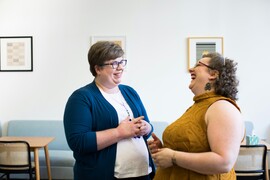
Our Bodies Ourselves supports every individual’s right to use the words for their body that feel best for them. We would like to get to the point where people use “fat” as a neutral, descriptive term, like we might use “tall” or “short.” As it is, we use it more as a term of defiance, much like nonheterosexual people often use the term “queer.” We actively avoid referencing Body Mass Index (BMI), because it has no predictive or descriptive value when it comes to an individual’s health. Also, the term’s historical and continued use actively harms fat people, especially those who are Black.
With the right resources and support, most of us can enhance our health, regardless of our size and shape. “Health at Every Size” is a framework Our Bodies Ourselves embraces. It aims to equip all people with tools for improving their health without regard to body size or shape.

As Health at Every Size notes,
“Accessing medical care is a process that is made difficult by the already challenging requirements of obtaining insurance, finding providers that accept it, and then finally carving out the time to make it to appointments.
However, it is especially complicated, and often off-putting, when you live in a body that medical professionals immediately label as ‘unhealthy.’
When you live in a larger body, you are met with fatphobia and shaming from the very people you are there to receive treatment from. They fail to treat–or take seriously–the symptoms you are concerned with by focusing instead on your body size by suggesting that weight loss is your only treatment option."
Body-shaming in all forms, whether inflicted by health care providers, family members, peers, media, partners, or others, has devastating and often life-long effects on women, girls, and gender-expansive people. Alternatives to fatphobia and fat-shaming include body-positivity–the idea that we all have the right to enjoy and feel proud of our bodies – and body-neutrality – focusing more on how our bodies feel and what they can do (rather than on appearance). The bottom line is, we all deserve dignity and joy in our bodies regardless of our sizes and shapes.