Our Bodies, Our Quilt
Our Bodies, Our Quilt is a national, multi-generational community quilt project that invites people to reflect on their bodily autonomy, their health journeys, and their relationships to Our Bodies Ourselves (OBOS). The project hopes to engage participants in meaningful expression and collective storytelling outside traditional clinical or policy spaces. We are currently creating a digital gallery of the dozens of quilt squares made with the theme of Survivorship during the pilot phase of Our Bodies, Our Quilt (2025-2026).

Current Theme: Every Body
On August 29, Our Bodies Ourselves and UN|HUSHED are hosting a consciousness-raising celebration of World Sexual Health Day. At this event, we will launch the next phase of Our Bodies Our Quilt, with the theme Every Body. As the World Association for Sexual Health writes,
Every person — for as long as they are alive — has a body, and ...what determines whether that body experiences sexual health, rights, justice, and pleasure is rarely the body itself.” It is the world that body moves through. The conditions that shape a person's sexual health are political, structural, economic, and social. They are written into policies and embedded in institutions. They show up in who gets believed in a clinical setting, whose pain is taken seriously, whose relationships are recognized, whose pleasure is considered legitimate, and whose body is treated with dignity. They are determined by power — and power is not distributed equally. The space between 'Every' and 'Body' is intentional. It asks us to hold both words in mind at once: every person, and the body they inhabit. Because sexual health is always lived in a body — and not all bodies move through the world on equal terms.”
We will provide materials to make quilt squares responding to the theme.
Reflection prompts:
- What is it like living in your body?
- How does your body move through the world?
- What would it look like for every body to have sexual health, rights, justice, and pleasure?
Your quilt square can reflect a personal experience, give voice to feelings and values, or issue a call to action. Of course, we welcome designs that note the place that Our Bodies Ourselves may have played in your journey.
This project includes multiple opportunities to share your quilt square and your story such as:
- A hand-assembled quilt using community-donated materials and labor
- A large-scale in-person community quilting event
- A public exhibit of the finished quilt
- A digital quilt gallery on the Our Bodies Ourselves website
The Pilot Theme: Survivorship (2025-2026)
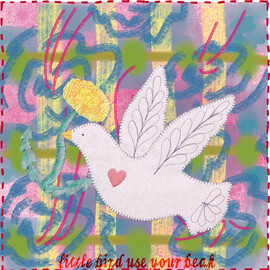
In our pilot “Our Bodies, Our Quilt” project, initiated by student intern Inés, we asked: What does survivorship of violence mean to you? Between September 2025 and January 2026, we invited the submission of individual, hand-crafted quilt squares and drawn or digital designs, along with optional written reflections. Each quilt square could reflect a personal experience, voice a political feeling, tell a generational story, or pay tribute to the role of Our Bodies Ourselves within a personal journey. Our goal was to expand OBOS’s work on gender-based violence, while reclaiming craft as a tool for memory, resistance, and care. This pilot demonstrated the potential for low-barrier, high-impact arts-based programming in gender-based violence prevention and survivor engagement.


Quilting History & Craftivism
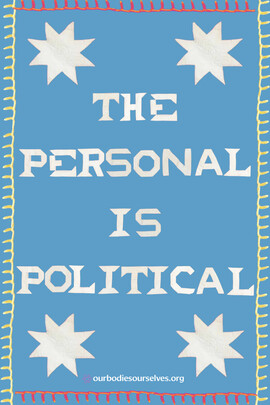
Quilting has long served as both a practical art and a radical form of resistance, especially for women, LGBTQ+ people, and communities whose voices have been systemically erased.
Fabric is not neutral. It has an intimate connection to the body because we use fabric to clothe, bind, swaddle, conceal, reveal, and protect. In this way, fabric mirrors the conditions of flesh. Quilting becomes a method of honoring that tension between decay and preservation, individual and collective, ephemerality and endurance.
Historically, quilting holds deep significance in Indigenous traditions, particularly among Lakota, Dakota, and Ojibwe communities. In the wake of colonial disruption, quiltmaking emerged as a practice of cultural survival.
The NAMES Project AIDS Memorial Quilt (1987-present) transformed personal grief into a national protest, memorializing those lost to the epidemic while demanding visibility and policy change. Similarly, The Monument Quilt (2013–2019), created by FORCE: Upsetting Rape Culture, assembled over 3,000 red squares with survivors’ stories of sexual and intimate partner violence. Displayed in a series of public places, it made survivor testimony unavoidable and affirmed that healing deserves space, both literal and political.
The Our Bodies Our Quilt project invites people to take part in that same lineage of expression, continuing the work Our Bodies Ourselves has always done: making room to name what happens to our bodies, what we feel, and how we relate to the world around us. This quilt becomes a way to document and to defy. Sewn together, we preserve not only individual experience, but our shared metaphysical conditions. The feminist artist and writer Betsy Greer coined the term “craftivism” to describe this practice. As Greer writes:
Craftivism is a way of looking at life where voicing opinions through creativity makes your voice stronger, your compassion deeper & your quest for justice more infinite.
In creating this quilt we honor the bodies whose voices, although stifled, speak through thread, through memory, through tough skin.
How to Make a Quilt Square