Menopause & Perimenopause
Menopause and perimenopause (the time leading up to menopause) are powerful biological processes. This transition from our potentially reproductive years to our non-reproductive years happens universally to all women and people identified female at birth (AFABs) who live long enough to experience it.
What do the different menopause-related terms mean?
People commonly use the word “menopause” to mean different things, which can lead to confusion! For clarity, Our Bodies Ourselves uses the following terms:
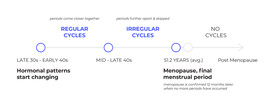
Pre-menopause is the time in our lives when our menstrual cycles are regular and we are ovulating.
Perimenopause is the winding down of our menstrual cycles -- just as puberty was the winding up. In this phase, hormonal patterns are less predictable and can lead to a wide range of changing symptoms. For most of us, perimenopause begins sometime between our late thirties and our early fifties.
Menopause is our final menstrual period. It’s an odd, look-back definition, because we reach menopause only after twelve months with no periods. So, you don’t know it was your final menstrual period until 12 months have passed without another one. Some of us reach menopause early and abruptly, owing to chemotherapy or radiation therapy, surgical removal of the ovaries, or other health conditions.
Postmenopause refers to the time after menopause. Most of us will live a third of our lives in this stage.
The Menopausal Transition includes both the perimenopause and menopause.
The menopause transition brings about many changes. Most of us will experience fluctuations in the flow of our cycles (heavier/lighter flow, fewer or more days of bleeding) and in the length of our cycles (often shorter at first, then later in the transition, longer). Some of us will also have new symptoms related to sleep, mood, memory, fatigue, vaginal changes, musculoskeletal changes, changes in libido, and yes, night sweats and/or hot flashes. While most of us will experience some signs or symptoms, some of us won’t experience any. For about 20 percent of us, the discomforts are so disruptive that we need major support and/or medical interventions.
For many of us, menopause and perimenopause are closely linked to cultural ideas and ideals about womanhood, femininity, and aging. Understanding what is happening in our bodies, knowing what to expect (and when), having access to the latest research, and hearing the stories and insights of other women and AFABs can help make this transitional stage of our lives easier to navigate.
For many of us, menopause and perimenopause are closely linked to cultural ideas and ideals about womanhood, femininity, and aging. Understanding what is happening in our bodies, knowing what to expect (and when), having access to the latest research, and hearing the stories and insights of other women and AFABs can help make this transitional stage of our lives easier to navigate.
Why Don’t We Know More about Perimenopause and Menopause?
For too long, menopause and perimenopause were rarely researched. Many factors contribute to this. Bias against women in medicine casts a long shadow over menopause research and treatment. The dominance of male physicians led to a view of women’s bodies as unworthy of rigorous medical research.
Sexism normalized the view that conditions affecting only women are not worth researching, because we’re just not that important, because our hormonal cycles make our bodies “too complicated,” because we’re “probably exaggerating” (generally untrustworthy to report our own experiences) when we say we have symptoms.
Even female lab animals are still usually excluded from medical research. This medical sexism is intensified by prejudice against older women. Rather than focusing on easing women’s perimenopausal symptoms and understanding their causes, most menopause research and treatment has primarily focused on keeping women “forever young.” Until the 1990s, Hormone Replacement Therapy (HRT) was the most heavily prescribed drug treatment in the country, prescribed to women starting at perimenopause and continuing for the rest of their lives.
While research has expanded, newer discoveries have not yet fully made their way into clinical practice. Second, medical training about perimenopause is minimal because the research upon which to base that training didn’t exist. This lack of research and training leaves many clinicians unsure of how to respond to symptoms; clinicians are often unsure which symptoms are perimenopause-related and which relate to normal aging. Further, there is broad consensus that MHT is good for VSM, but there is still debate about whether it is good for preventing chronic illnesses such as cardiovascular disease and dementia.
Our Bodies Ourselves’s resources provide an evidence-based understanding of perimenopause and menopause. They examine the biology of the menopause transition, offer approaches to managing symptoms, explore how cultural attitudes and expectations affect us, and feature the stories and experiences of people going through these changes.