Thoughts on Reading and Re-reading the “Lesbian Chapter”
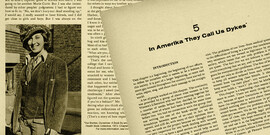
When I first read the 1973 chapter “In Amerika they Call us Dykes,” I grinned like a fool, for the title itself captured my heart and soul. 52 years later after its publication, it seems the internal dialogue of begrudging Dykes has been passed on generationally to each carpet muncher and misandrist. There is much to say about its white feminist constraints and lack of inclusion of diverse Dyke perspectives, yet its power of voice is undeniable. In the age of the oxymoron of Lockheed & Martin Pride, it’s easy for some to believe that homophobia, or more specifically lesbophobia, is a thing of the past as if public complacency simulates equity. But texts like this remind us of the vulnerabilities and violences that haven’t gone anywhere. They show us the wounds that still haven’t healed.
For those who don’t identify as Dykes, it can be hard to understand the strength this word carries. When I picture Dykeness, it’s not visual stereotypes. It’s the clarity of Nancy’s line:
“That night I made love to her in a way you only can with someone whose pleasure you love.”
Indulge in this quote, not through oversexualization, but by honoring its eroticism. It’s erotic because it’s real, rooted in care, not domination. That eroticism emerges from the choice to live beyond the boundaries of patriarchy, and to love one another with full political and spiritual presence. It’s not about being cast out by society for the sake of exile, but about recognizing that only through rejecting patriarchal norms can we find the possibility of unupholstered, unfiltered love. And through this attention to pleasure, we begin to understand the inverse: what it means when pleasure is stolen. When bodies are taken, when touch becomes harm, when violence is cloaked as intimacy. The ability to hold and be held with care makes visible all the times women were touched without care, without consent, without humanity. Dykeness demands we pay attention to that contrast. It reveals the scale of violence that women are forced to endure, not just physical rape, but the rape of the mind, of autonomy, of the soul. It shows how deeply rape culture is embedded in everyday life, in medicine, in law, in family, in language.
I’m reminded of the time when I was 17, and in psychiatric inpatient for anorexia, a sardonic reflection of my struggles in my sexuality and pleas for male validation. While there, I became close with the only other out lesbian. We cracked jokes about needing to recover because we were unable to get wet anymore and our pitiful predicament of bodily mutilation for societal acceptance. Our friendship which was strictly platonic was consistently demonized by psychiatric staff as they could not understand how our mutual identity was our saving grace, not an express route to sex. We were given demerits for being in each other’s rooms, sitting close to each other, and god forbid showing physical affection. Someone started a rumor that we were showering together, like some scene from a straight-man’s porno fantasy, and I was nearly kicked out of treatment and further kicked into the closet. My experience is mirrored by Molly’s section on psychiatry, the disbelief that lesbians can form bonds outside of sexual deviancy, the pathologization of female closeness, the violence of medical systems that confuse discipline with care. That section, like so much of the chapter, names what so many of us have felt but were never allowed to say out loud. It exposes not just how Dykes are treated, but why we are treated the way we are. That our love, our solidarity, our refusal to submit, threatens the systems built to control us.
Now they still call us Dykes, and they still mean it as an insult. But we are still here. Still writing. Still laughing. Still loving each other out of the wreckage. “In Amerika They Call Us Dykes” gave language to that survival. It dared to tell the truth before the world was ready to hear it, and in doing so, it created a blueprint for how we might name ourselves and refuse to be named by others. I am grateful for this text, not because it’s complete, but because of the devout gift of exploration. May the next generation’s bedtime prayers not beg for softness or safety but the irreverent declaration: “God, turn me into a Dyke!”