“In Amerika They Call Us Dykes”: The Evolution of the Lesbian Chapter in “Our Bodies, Ourselves”
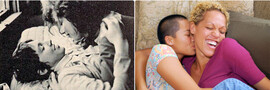
Alongside the burgeoning feminist awakening of the late 1960s, the nascent gay liberation movement prompted many to question their sexuality, their relationships, and their ways of being in the world. This new openness included the writers, and readers, of “Our Bodies, Ourselves.”
It’s notable that the very first stapled, newsprint edition of “Our Bodies, Ourselves” (1970) included a short section on “homosexuality.” Respectful attention to homosexuality was rare in American publications at the time. The previous September’s Stonewall riots had sparked a new era of activism for gay rights and gay pride, but discrimination was still rampant and psychiatry classified homosexuality as a mental disorder.
In the mass-market 1973 edition of “Our Bodies, Ourselves,” the brief “homosexuality” section transformed into its own full chapter: "In Amerika They Call Us Dykes." Because there were no out lesbians in the Boston Women’s Health Book Collective at the time, the BWHBC asked another Boston collective called Lesbian Liberation to write the chapter. The publisher, Simon and Schuster, had misgivings about the plan, and the BWHBC had to defend the chapter’s inclusion in the book.
In keeping with the broader movement for gay liberation, the chapter’s very title defiantly reclaimed the word “dyke,” an offensive term for a gay woman. Hundreds of lesbian readers wrote to the Boston Women’s Health Book Collective in response, sharing their own stories of coming out, falling in love, facing homophobia, and demanding their rights. Their letters expressed relief at finally having access to affirming knowledge. The chapter also challenged straight readers to rethink their assumptions about homosexuality.
Over the next 40 years and across nine U.S. editions of “Our Bodies, Ourselves,” the “lesbian chapter” continued to explore the lives and experiences of lesbians, bisexual women, and queer and trans people. The chapter’s evolution reflects changes in language as well as changes in cultural understanding of sexual orientation and gender identity.
To learn more, see:
"In Amerika They Call Us Dykes"
The full, original chapter as published in "Our Bodies, Ourselves" in 1973 was written by Lesbian Liberation, a gay collective based in Boston.
“In Amerika They Call Us Dykes”: The Evolution of the Lesbian Chapter in “Our Bodies, Ourselves”
A wonderful paper, written by Rachel Looff, that takes an in-depth look at how the first chapter – which was written not by the founders of the Boston Women’s Health Book Collective but by an anonymous gay collective – came to be. It examines the conflicts and solidarity between the groups as well as the defining role of lesbians in the women’s health movement.
In America They Call Us Empowered: Lesbianism and “Our Bodies, Ourselves”
Written by Melinda Schottenstein, this paper shows the impact of the chapter, and how, by removing the stigma of lesbianism, it united and empowered the gay and straight feminist communities.
Reexamining Gender and Sexual Orientation: Revisioning the Representation of Queer and Trans People in the 2005 Edition of “Our Bodies, Ourselves”
Elizabeth Sarah Lindsey, the author of the new 2005 chapter, Gender Identity and Sexual Orientation, talks about her goals in writing the chapter: for readers to understand the difference between sexual orientation and gender and to understand that gender isn’t always determined by sex.
GLBTQ Representation in “Our Bodies, Ourselves”
In this video presentation, OBOS founder Wendy Sanford and 2005 book contributors Shannon Berning, Elizabeth Lindsey, Gordene MacKenzie and Hawk Stone talk about how the book grew and changed to serve lesbians, bi women, and trans people.
Writing the Relationships Chapter: How a Conversation Became the Text
In 2010, in preparation for writing for the next edition, OBOS organized an online discussion forum on relationships and sexuality. The 37 participants identified as straight, lesbian, bisexual and asexual; married, partnered and single; monogamous and polyamorous; cisgender and transgender. The 2011 edition did not have a unique “lesbian” chapter, but instead featured the stories, perspectives and experiences of the participants throughout the four chapters on relationships and sexuality.