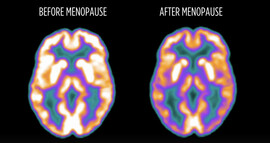
Menopause Effects on the Brain
In this TEDWomen Talk, neuroscientist Lisa Mosconi discusses how the hormones associated with menopause affect women's brains. Women and men have equal mental abilities, and there is no such thing as a gendered brain. But two-thirds of the 6 million people with Alzheimer's Disease are women.
Mosconi found that women's higher rates of Alzheimer's Disease are connected to menopause. Hormones lead women's and men's brains to age differently. During menopause, brain energy decreases along with estrogen levels. And the number of amyloid placques in women's brains increase during menopause. These brain changes increase the risk of Alzheimer's, even though symptoms of the disease may not appear until later.
Having a hysterectomy or oophorectomy, procedures that can cause menopause to occur sooner, can also increase the risk of dementia. But we can make changes to our lifestyle to improve the health of our brains.
Note: Mosconi does not discuss trans and non-binary people and her talk uses the terms sex and gender interchangeably. Also note that there is no evidence supporting estrogen as an effective therapy to prevent dementia or Alzheimer's Disease.
We think of menopause as belonging to middle age and Alzheimer's as belonging to old age. But in reality many studies, including my own work, have shown that Alzheimer's Disease starts with negative changes in the brain years if not decades prior clinical symptoms. So in women, it looks like this process starts in midlife, during menopause. Which is important information to have because it gives us a timeline to start looking for those changes.
SOURCE: TEDWomen • AUTHOR: Lisa Mosconi • LAST UPDATED: December 1, 2019