Gender-based Violence
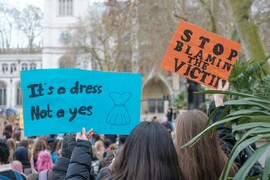
Gender-based violence (GBV), like all types of violence, limits our ability to live free and full lives. GBV includes violence against someone because of their gender–generally women and girls, but also gender-expansive people and sometimes men or boys. It takes many forms: sexual assault, intimate-partner violence, dating violence, trafficking, stalking, and harassment. Sometimes an individual person inflicts that violence, but entire societies can also be violent – for instance, in what’s called “rape culture,” an environment in which sexual violence gets normalized and excused. The roots of all gender-based violence lie in gender inequality, the abuse of power, and sexist norms. The resources in this section look at the kinds of violence we experience, our struggle to survive and heal, and the movement to end gender-based violence.
Violence against women and gender-expansive people is pervasive around the world. Globally, one in three women will experience sexual or physical violence in their lifetime. In the United States,
- One in three girls is a victim of physical, verbal, or emotional abuse.
- More than three women per day are murdered by their male partners.
- One in four women experiences domestic violence during our lifetimes.
The more marginalized and vulnerable we are, the more we are attacked as “easy prey.” Young women, low-income women, women of color, trans women, immigrant and refugee women, elderly women, sex workers, queer women, women with disabilities, trans women, and gender-diverse people are all victimized at higher rates. If we are multiply oppressed–say poor and queer–we are subject to even higher rates of violence.
Women’s movements around the world have been working to raise awareness of, prevent, reduce, and meaningfully respond to gender-based violence (GBV) for generations. We have made important strides, especially since the 1970s. Because of feminist organizing, the World Health Organization recognizes that sexual violence, intimate partner violence, and other abuse of women and children are epidemic public health problems. Similarly, the International Criminal Court in The Hague now recognizes militarized rape as a war crime. In the U.S. and many other countries, some law enforcement agencies provide specialized training for officers dealing with GBV.
Yet GBV is still considered so acceptable or unavoidable that many women who experience it feel that they are at fault or have no right to complain about it. We have a lot of work to do to counteract gendered violence and rape culture and to create a world that is safe for all of us.