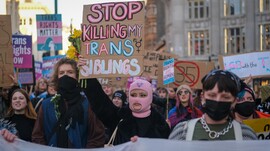
Trans Misogyny and Trans Violence
Trans misogyny has contributed to trans violence throughout time, but what is trans misogyny? In this episode of the ACLU’s "At Liberty" podcast, historian and gender scholar Dr. Jules Gill-Peterson discusses her book "A Short History of Trans Misogyny" and how it relates to her personal experiences as a trans professor of color.
Gill-Peterson explains that trans misogyny is fueled by homophobia and occurs when someone is assumed to be a man and thus assumed to be a threat. In trans misogyny, men name themselves as “victims” of trans women to justify their violence against trans women. Because trans misogyny aims at the ways that gender is sexualized, even gay men and cisgender women can be subjected to trans feminization or assumed to be trans. This can in turn subject them to trans misogyny and thus trans violence.
Dr. Gill-Peterson traces the history of trans misogyny and trans violence to sex work in India under British colonization. In India, hijras were males who were initiated into a discipleship where they lived as girls and women in India. This transgression caused a moral panic among the British, who criminalized the hijras. They used trans misogyny to justify their colonization of India.
Dr. Gill-Peterson concludes with a discussion of the United States context. Street queens experienced greater hostility because they wore drag in public, in contrast to drag queens who performed more privately in clubs. Gay and lesbian activists often distanced themselves from street queens. This led to the formation of organizations like STAR (Street Transvestite Action Revolutionaries). It is these organizations and people like Sylvia Rivera and Marsha P. Johnson who can inform our politics today.
So I think the street queen is just someone we should go back to. We should come back to her power. We should think about the kind of world she was demanding. You know, she was more interested in abolition, right, than representation. And I just think like those are great touchstones.
Dr. Gill-Peterson also discussed her new book on NPR’s "Code Switch" podcast. In addition to the content discussed in this ACLU podcast, she contextualizes the introduction of the word transgender and how it was shaped by both class and racial dynamics. The word transgender developed to differentiate trans women sex workers, often poor women of color, from a gay middle-class. On "Code Switch," she details the policing of Black trans bodies, centering Mary Jones. Mary Jones was a free Black transwoman and a sex worker in New York in the 1830s. She is an early example of the criminalization of sex work and the policing of trans bodies in the United States. Dr. Gill-Peterson concludes her interview by offering that if we can live in solidarity with Black and Brown trans people, we can all get free.
SOURCE: ACLU: At Liberty Podcast • AUTHOR: Kendall Ciesemier • LAST UPDATED: June 6, 2024