Black Women, Birthing People, and Maternal Mental Health
This fact sheet by the Maternal Mental Health Leadership Alliance provides information on Black birthing people and maternal mental health.
Mental health conditions during pregnancy and up to one year postpartum include depression, anxiety disorders, post-traumatic stress disorder, psychosis, and substance use disorders. Seventy-five percent of women with maternal mental health conditions do not receive treatment.
These rates are even worse for Black birthing people because of social and economic factors like unequal access to resources, stable employment, and environmentally safe places to live. They experience gaps in medical insurance and barriers to high quality health care. Their conditions go unrecognized more often because current diagnostic tools don’t recognize the symptoms in Black birthing people. They are underrepresented among medical providers, making it difficult to get culturally competent care.
Also our culture pressures Black birthing people to mask their struggles. They feel like they must be strong and hold everything together. History has taught Black patients to distrust the medical system and mental health remains stigmatized. Experiences of chronic stress (called "weathering") age our bodies, which further complicates Black women's conditions.
This fact sheet includes nine concrete strategies to remove the barriers imposed by structural racism. We must develop better screening tools, policies, and curricula that reflect the experiences of Black birthing people. Partnerships with community organizations will ensure that we provide holistic and culturally competent care and advocacy.
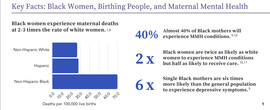
Black women are twice as likely as white women to experience MMH conditions but half as likely to receive care.
SOURCE: Maternal Mental Health Leadership Alliance • AUTHOR: Niaja J.E. Nolan, Krystal Leaphart, and Dr. Terri Wright • LAST UPDATED: July 1, 2023