Breast Cancer
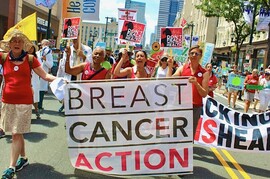
Breast cancer is a general term referring to uncontrolled cell growth that originates in breast tissue, causing tumors. Breast cancer cells begin inside the milk ducts, also known as the milk-producing lobules, of the breast. These cells can remain in situ (in place), spread into nearby breast tissue causing lumps or thickening, or spread to nearby lymph nodes or other organs. When the cancerous cells spread (metastasize) to lymph nodes or other organs, the breast cancer is considered “metastatic.” We now know that breast cancer is not a single condition. Rather, recent molecular and genomic research have identified dozens of different types and sub-types of breast cancer. These different types have different trajectories, prognoses, and optimal treatments.
For many of us, the words “breast cancer” evoke strong feelings and raise difficult questions. Is it a death sentence – a demon, lurking in our DNA or hiding in the corners of our cells, ready to attack? Is it triggered by our failure to exercise sufficiently, eat properly, lose weight, control stress, or give up an occasional cigarette or glass of wine? Perhaps we feel shame at the public exposure of an intimate body part. Some of us respond to breast cancer with anger, seeing rising rates as the result of environmental degradation gone wild. We may be told that it is an enemy we can vanquish by developing a positive attitude and a warrior spirit.
Our breast cancer experiences are shaped both by cultural attitudes and by access to appropriate medical attention. College-educated and affluent women may be encouraged to ask doctors questions, request second opinions, and seek care at major cancer centers that offer the latest and most effective treatments. Poor women, women of color, and LGBTQAI+ people may encounter racist, homophobic, and other negative interactions from clinicians and hospital staff. In rural areas, women may live hundreds of miles away from hospitals offering up-to-date treatment, making access to care out of reach for many. All but the very wealthy may find breast cancer treatment unaffordable.
The Big Picture
Breast cancer diagnosis and survival rates vary dramatically among countries. In the US, for example, the survival rate is approximately 91% while in South Africa the survival rate is 38%. According to the World Health Organization, in countries with a very high Human Development Index (HDI), 1 in 12 women will be diagnosed with breast cancer in their lifetime but only 1 in 71 women diagnosed die of it. In countries with a low HDI, only 1 in 27 women will be diagnosed with breast cancer in their lifetime but 1 in 48 women die from it. These numbers reveal enormous disparities, with women in wealthier countries more likely to be diagnosed but less likely to die of breast cancer than women in poor countries.
Breast cancer rates around the world have risen in recent decades. This rise is due to a variety of factors. As life expectancies increase, more cells in our body have time to mutate; in other words, aging in and of itself is a “risk” for cancer. In the past – and still today in poorer parts of the world – many people died at younger ages from infectious diseases. Nowadays, especially in more developed countries, most people live into adulthood and thus have “time” to develop cancer.
While western medicine generally focuses on the individual causes of cancer (genetics, so-called “life-style” choices), 50–70% of women diagnosed with breast cancer have no known risk factors. Rather than looking exclusively at individual risk factors, it’s important to acknowledge that a wide range of recognized carcinogens have entered our environment, including our air, food, cosmetics, building materials, and water. Environmental toxins can interfere with hormone systems, cause DNA damage, and promote tumor growth.
High rates of diagnosis, especially in wealthier countries, are partly due to funding and campaigning for early detection of breast cancer. More detection translates into more cases being identified. Especially in western countries, some of us have come to accept breast cancer as a quasi-normal phase in the modern female life-cycle. Breast cancer can also be over-diagnosed, with early detection picking up small growths that would never develop into a serious condition.
It is crucial to distinguish between prevention and early detection (which is sometimes confusingly called “secondary prevention”). While we are happy that modern medical practices have made breast cancer a highly treatable disease for most women in wealthy countries, the fact remains that a breast cancer diagnosis and breast cancer treatment are still devastating both emotionally and physically. Strides in addressing breast cancer have focused on detection and treatment rather than prevention. Lack of adequate wide-scale regulation of environmental toxins, together with the enormous profits generated by the early detection and treatment industries, may explain why more funding goes into detection and treatment than prevention.
As recently as the 1980s in the United States and elsewhere, women were expected to be ashamed or embarrassed by breast cancer. As a consequence, diagnoses were delayed and women struggled to access services or support. We applaud social and cultural changes over the past half century that have moved breast cancer out of the shadows. Women now can talk openly about breast cancer and join together in support groups and information networks.
At the same time, we are appalled by contemporary “pinkwashing,” a marketing strategy that minimizes women’s suffering and normalizes breast cancer as a fairly expected part of the female life cycle. Portrayals of survivors as “warriors” decked out in pink obscure the lived reality of millions of women who undergo surgery, chemotherapy, radiation, pain, mutilation, decades of fear and surveillance, and for far too many of us, death.
Breast Cancer Trajectories
Each woman’s breast cancer trajectory is unique, but there are general stages that can help us make a bit of order out of the avalanche of available information and anecdotes. Not all women experience all of these stages; some women experience some of these stages more than once; and most of us find that these stages overlap.
- First suspicion. Many of us feel a change in our own breast tissue. Others are alerted to the possibility of breast cancer through a mammogram or other imaging procedure.
- Diagnosis. Diagnosis typically involves more imaging, blood tests, and a biopsy of the breast tissue. This process can feel incredibly rushed or unbelievably slow.
- Surgery. Surgery which may include lumpectomy, mastectomy, and sampling of lymph nodes.
- Post-surgery. There often is a more precise diagnostic investigation as well discussions regarding further treatment.
- Active treatment. May include chemotherapy, radiation therapy, hormone therapy, immunotherapy, and other emerging treatments.
- Breast reconstruction. Some women opt for surgical reconstruction of their breasts. This is a multi-stage process, and all of its parts may not be available in every situation.
- Maintenance. Depending on the type of cancer, some women are prescribed hormone or other therapies for the long term.
- Surveillance. Most women are put on a schedule of surveillance to monitor future signs that the cancer has returned or spread. Typically this involves regular CT Scans and other tests and imaging.
- Recurrence. Some women find that the cancer has returned, grown, or spread (metastasized ) to other organs. Rates of recurrence are quite different for different forms of breast cancer. Not all women experience recurrences.

with special thanks to Susan Sered for leading the writing of this introduction